Kinbaku is the Japanese art of erotic binding, also known as shibari.
This page focuses specifically on the aesthetic, emotional and relational aspects of kinbaku. For the meaning of the terms and the linguistic differences between shibari and kinbaku, read our in-depth article on shibari and kinbaku.
There are several schools within this discipline, which have developed different techniques for sensually restraining a partner’s body.
The aesthetic aspect is fundamental in kinbaku. The beauty of the knots and the elegant arrangement of the rope on the body should enhance its forms and emphasize its sensuality.
This attention to aesthetics is also a metaphor for the care that the person tying must show toward the person being tied while creating an emotional as well as physical bond.
Rope is an excellent tool for creating intimacy between two people who want to share moments of intense yet refined eroticism.

The historical origins of kinbaku aesthetics
This form of sensual restraint evolved from techniques used to capture prisoners, refined between 1200 and 1600, and from later interrogation techniques developed between 1600 and 1868.
In the twentieth century, rope ceased to be an instrument of restraint used by political authority, but remained part of popular culture through kabuki theatre.
Some particularly evocative theatrical scenes captured the imagination of Ito Seiu, who in 1930 began photographing various models after tying them.
Kinbaku and shibari: a note on terminology
The term Kinbaku first appeared in written form in 1952 in the magazine “Kitan Club”. It is a word of Chinese origin and therefore has a more formal sound than the analogous Japanese word “shibari“. Both terms are used in Japan to refer to rope bondage. For the linguistic differences between the two words, you can read this article on our website.
On this page you will find answers to some of the questions that may arise when someone approaches this discipline for the first time:
- What constitutes beauty in kinbaku?
- How can beauty be found in suffering?
- What kind of relationship develops between two people sharing a kinbaku session?
- What motivates practitioners to engage in a kinbaku session?
The beauty of kinbaku
Kinbaku literally means “tight binding”. Some interpret the adjective “tight” in the sense of making movement completely impossible. It is in this feeling of total restraint — to which one must necessarily surrender — that we should look for the beauty of kinbaku.
In the West, beginners often look for the beauty of bondage in the geometric patterns that ropes create on the body. According to the principles of Japanese aesthetics, however, beauty can instead be found in the rough imperfection of something unique and unrepeatable. Masters of the tea ceremony seek to appreciate the unrepeatable nature of the present moment (“ichi-go ichi-e”); the best kinbaku practitioners similarly seek to use rope to enhance the emotions shared in a moment that will never return.
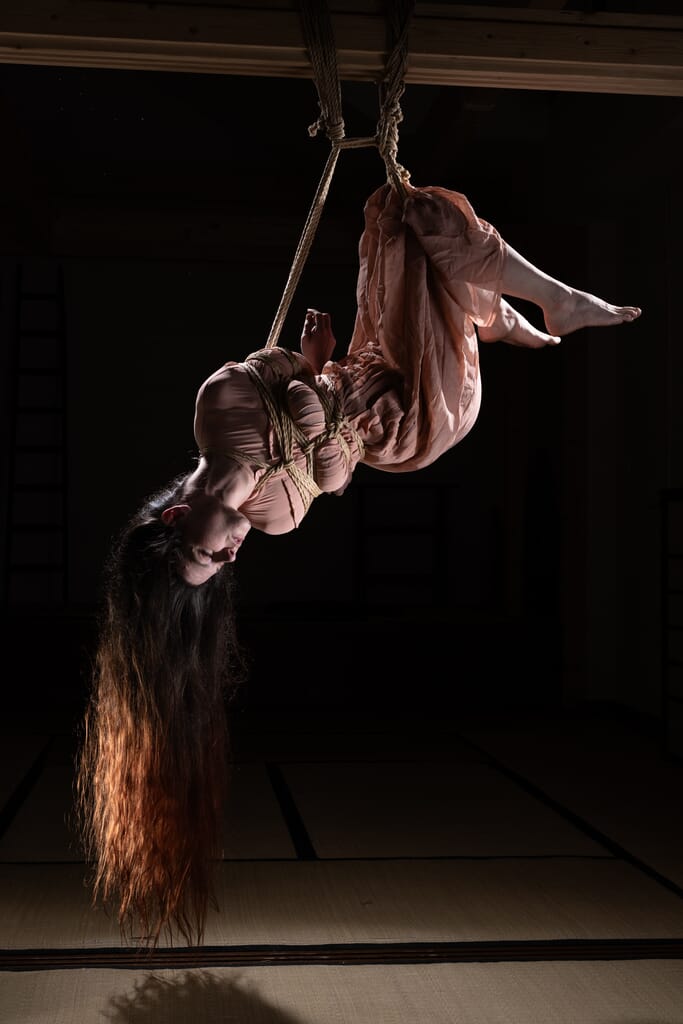
Order and chaos in the aesthetics of kinbaku
A geometric design strikes the eye decisively, in a way the Japanese might describe as hade (派手); however, according to Japanese aesthetics, there is a more refined kind of elegance. In Japan, the greatest admiration is often reserved for subtly suggested beauty, for a subject that delicately emerges from an apparently uniform background. One of the most admired landscapes is a snow-covered one. By making the entire background uniform, the snow enhances the subject that subtly emerges from it, merely suggesting its presence.
In the same way, the most appreciated tying is one in which no single rope catches the observer’s eye too obviously; one in which the ropes do not display an explicit geometric order, but instead create a harmony that can only be perceived as a whole. From this overall harmony of the ropes, the bound person gently emerges, lost in the universe of their own imagination, passive and quietly surrendered to the suffering they are experiencing.
The beauty of kinbaku lies in the body of the person being tied as it is challenged by the rope; in a drop of sweat forming on the forehead through exertion; in the surrendered expression of someone living an experience that is emotional before it is physical.
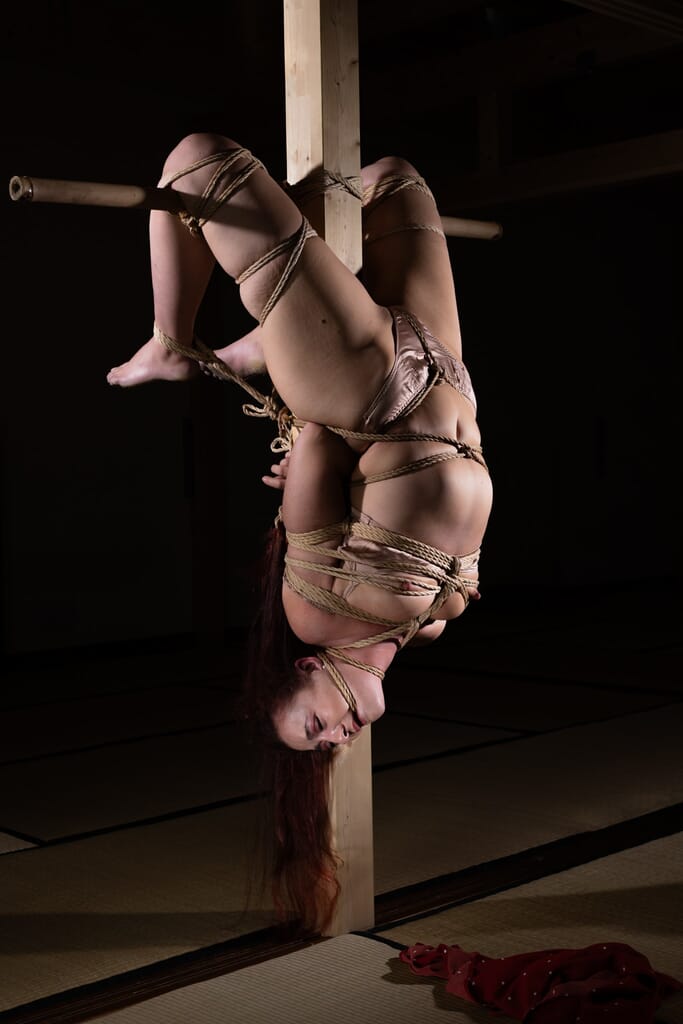
The aesthetics of suffering
The quiet acceptance of suffering is one of the aspects most appreciated by admirers of kinbaku. The roots of this appreciation can be found in the dynamic that develops between the person tying and the person being tied. Looking for someone simply because they are inclined to “endure pain” is far too crude an approach to what we are describing. We are not talking about pain that must merely be endured, but about suffering that is experienced together.
In kinbaku, the person tying and the person being tied remain connected by deep empathy and together overcome a moment that challenges the body and mind of both. Pain is not simply something to endure, but something to experience. The acceptance of suffering created by the ropes becomes a reflection on the transience of things: does suffering itself not austerely remind us of our mortal condition? Is it not precisely by overcoming a moment of suffering that some of the greatest joy can arise? How, then, could we not find beauty in the interaction between two human beings who contemplate their own impermanence together through a moment of suffering that is shared and overcome?
Kinbaku: two people, one spirit
Kinbaku is a moment of sharing. Two people bare their souls to one another. Total trust is clearly a prerequisite. The person being tied must know that the person tying will take care of their physical and psychological safety; the person tying must be able to trust the other person’s honesty about their limits, fears and state of health.
Western practitioners often focus first on the sequence of positions they intend the bound person’s body to assume during a session. Japanese practitioners, by contrast, more often seek the intensity of the emotional experience. The master Yukimura Haruki said that tying is like accompanying the bound person into the universe of their imagination. Tying becomes a way of exploring together a Wonderland that exists within the inner world of the person being tied.
This is not a simple exploration. It can brush against the deepest fears and traumas of a person who finds themselves helpless before the person tying them. The person tying undertakes this journey carrying their own baggage of insecurities and frustrations; they walk through a forest where delicate flowers grow and can easily risk leaving unwanted traces behind.
The fascination of what frightens us
What drives two people to face all of this? There are naturally as many answers as there are practitioners, but it is undeniable that — particularly when speaking about kinbaku — what frightens us a little can very often fascinate us.
A session is an opportunity to share and overcome a difficult experience together. This can create a strong bond between two partners. In the words of Naka Akira: “It’s like climbing a mountain together.” The intensity of the sensations and the depth of the emotional effort can leave both partners in a state of grace, deeply aware of themselves and of each other.
The beauty of sharing, however, does not diminish the importance of each person’s individual experience.

Individual motivations of kinbaku practitioners
For the person being tied, relinquishing control is often a source of relaxation and can provide an outlet for the pressures of a demanding professional life. The intensity of the physical challenge can also affect self-esteem and, for many people, become a way to build greater self-confidence.
For the person tying, it can be deeply rewarding to contemplate the gift of trust offered by the person being tied. The awareness of having played a central role in the state of grace and surrender that someone may experience after a good kinbaku session can also be a source of profound inner satisfaction.
For those with the right frame of mind, kinbaku can be a profound experience that, over time, may even become indispensable. Every session offers an opportunity to enrich oneself and the other person emotionally and spiritually; every tying experience can strengthen the relationship between the two participants.
It is often difficult for a single kinbaku course to convey all of these concepts. For this reason, the educational path of School of Rope continues through opportunities for regular practice. In Milan, these activities take place at Yugen Studio, our operational venue, where students can practise regularly and develop not only the technical skills required for tying, but also the abilities needed to create the context for a meaningful kinbaku session. You can find our courses and ongoing practice activities in Milan here.
Kinbaku and photography
Kinbaku has been represented since its earliest days through magnificent, powerful and dramatic photographs. By creating these images, the pioneers of the discipline helped give shape to many of the iconic forms we know today.
We suggest exploring the subject further by starting with the biographies of some of the earliest masters whose work has left a trace. Among them:
- Itou Seiu
- Minomura Kou
- Nureki Chimuo
- Akio Fuji
- Sugiura Norio
Even today, photography remains an important medium for spreading appreciation of this discipline. Rope Tales works to keep this tradition alive through the Yugen Studio Magazine project. It is a quarterly publication produced at our studio in collaboration with our students as well as respected professionals in the field.