When Kirigami told me he would start studying the tea ceremony, I had been away from Milan for a couple of months. I knew it would only be a first lesson but I still felt a note of jealousy.
His first class would’ve been one-to-one with a Japanese teacher and he was excited like a child on his first day of school. When I got back we decided to continue this path together.
I’ve always been attracted by rituals, by any kind of choreography. After 17 years studying ballet, anything related to body and mind, or connected with elegance, fascinates me.
I had never seen a tea ceremony, I didn’t know much actually. I just saw a few photos showing moments from the long ceremony. I suppose I felt thrilled like our students at the rope school.
I wore a white flowered dress , made a bun, put my tabi in a bag and went to my first tea ceremony.
First time in the tea room
In front of the teacher’s house I feel nervous. Kirigami told me something about the ceremony but I knew very little about how I’m meant to behave and knowing something about Japanese culture I’m afraid of making mistakes, being clumsy or even rude. I repeat to myself that the teacher will understand my mistakes are mainly caused by inexperience but when she opens the door I’m still embarrassed. I bow and wait for her invite to enter her tiny home.
At the entrance we see a sort of art studio. She paints, very well actually! I also notice a particular fascination for Canova and my eyes light up, not only because it perfectly fits my taste, but also because this confirms many of my beliefs about aesthetic research.
I take my shoes off, wear my tabi and wait. At my side, Kirigami is more at ease than me.
After a few minutes another girl walks into the room to take lesson with us. It’s her first time too. When we are ready we walk down the small and narrow stair to the tea room.
The ceremony
Kiri is the first guest so he has to enter the tea room first. Our teacher shows him the proper way and he repeats it by the book, just a bit clumsy and tied by his clothing. Than the teacher shows me how to do the same. How to enter the room, how to walk, how to bow down and stand in the seiza position. It’s totally new to me. Some sort of weird choreography to learn and repeat. I do my best.
I go down in seiza on the tatami and, with my hands into a fist, I enter the tea room and bow on the mats. I stand up on the diagonal she showed before, walk towards the calligraphy on the wall and gently go back down in seiza. I look at the calligraphy and bow, I look at the flowers and bow…
I stand up and turn, go back across a new diagonal and walk toward the kama (the tea pot); then I go down in seiza, bow and stand up again to return to my spot, next to the first guest. When we are all ready in seiza, the teacher starts her ceremony, telling us that if we can’t hold the position we can sit on the tiny stools prepared for occidental guests. She knows it can be hard for us.
She explains every single movement but she doesn’t say why, she only says what and how.
Her movements are precise, elegant and smooth.
I’m in seiza in my spot, trying to understand the sequence but it’s hard to memorize.
Kirigami performs the ceremony as a first guest, makes a few mistakes and tries again. When he makes something particularly well she highlights his ability. She’s amazed when he anticipates her movements, especially when he takes the sticks from her hands to put them back on the tray. She didn’t expect it. It seems to be a common mistake among occidental guests.
I’m more and more anxious to forget some movement and make mistakes.
After about half an hour my ankles start hurting. Kiri and the girl are already on the stools and I’d really like to do the same but it’s my turn and I have to hold the position.
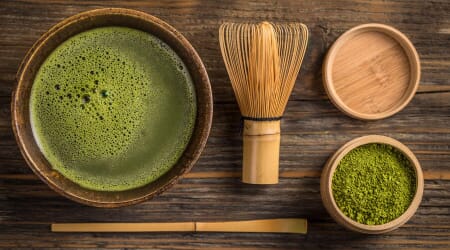
The teacher starts again cleaning the chawan (the tea cup) and preparing my macha.
I have to drink the tea, watch the cup and flip it to give it back to her. I have to act gently but I’m suffering. I can’t feel my feet and it’s difficult to stand up at the end of my turn. When the girl has finished her macha our teacher concludes the tea ceremony cleaning the crockery. After the ceremony we have time for some questions and we have many. We ask about the crockery and the ceremony in general and she answers all our questions before letting us go home.
Folding a chakin
A few weeks later, we are at our second class, just Kirigami and myself this time.
We start folding the chakin (the tea towel), as she asked. We don’t know what’s for but it’s probably impolite to ask. We repeat the sequence about 10 times before walking down the stairs to the tea room.
This time it’s my turn to be the first guest. Luckily, our teacher shows me again how to enter the room, walk and sit down, saving me the embarrassment. I try to repeat the sequence but I make a few mistakes and I have to start again. Kirigami does the same and then the teacher does it again.
At the end of the ceremony, I can’t wait to ask a few questions. I try to limit myself because I understood questions are not polite in her culture, but I also imagine she’s used to occidental students and to our way to learn.
Every time I learn something new I think about my students, imagining their feelings so similar to mine. I compare my moments in the tea room with theirs at our school.
I’m not only learning the tea ceremony, I’m also back being a student: an occidental student facing an oriental discipline. It’s not easy at all. It’s so different from ballet, maybe similar in elegance, movements and rhythm, but certainly far from our methods.
Femininity and elegance in Japan
Among my few question I ask about a particular movement women do differently from men when they are in seiza to move from their position. I ask if it’s because of the kimono, assuming it could be a logical reason. She answers: “It’s more graceful and gentle”.
She doesn’t say much but it’s everything to me. It may seem approximate but it isn’t. It’s just easy, like her gesture and it’s full of meaning.
I’m not sure I’ve understood her answer completely. Maybe my ballet background helps me to accept it as is: an easy answer for a graceful gesture free from technique and made of precision, elegance and smoothness. It’s just beautiful.
I don’t know anything about the tea ceremony and two classes are not enough to understand such a complex ritual. I’m intrigued and I really want to reach the same elegance in gestures to make it smooth and free from technique. It’s like tying. We learn how to manage the technique to be able to forget it and focus on the elegance and beauty of a human body.
______________________
Thank you Marianna for the translation